Teacher Takeaway Podcast
  • Home
  • Podcast
    • Live Streams
  • Show Notes
  • Suggestion Box
  • Home
  • Podcast
    • Live Streams
  • Show Notes
  • Suggestion Box

                  Teacher Takeaway


                 Show Notes

S1, EP 21: CV Writing and Job Interviews

18/10/2021

0 Comments

 
Picture

How do we engage effectively with the job application process?

Writing a job application and interviewing for a teaching or leadership position can be a complex process that requires a strong understanding of the context and position you are applying for. 
In episode 21, the Teacher Takeaway team discuss tips and tricks for writing job applications and interviewing for a job in education, including:
  • research (1:00)
  • cover page (6:30)
  • cover letter (9:45)
  • formatting (18:26)
  • addressing the criteria (24:30)
  • common mistakes (37:30)
  • interviews (49:22)
  • EOIs 

Research

When you come across a teaching or leadership job that you think you might like to apply for, there are some key things you should do, such as:
  • learn more about the school and its context
    • look at the school newsletter
    • examine the school website
      • What kind of events do they do?
      • Are staff participating in it?
      • Is the community involved?
    • explore the school facebook page
  • thoroughly examine the school plan
    • examine the three strategic directions and identify the key initiatives
      • What curriculum initiatives are they implementing?
      • Are they focusing on inquiry based learning?
      • Do they have a key signature or pedagogy around explicit instruction?
      • What type of welfare initiatives do they have?
    • examine the iniatives against the selection criteria because the school will be looking for someone who can support and bring skills, knowledge and expertise to these areas

Is this the school for me? Is this the right place for me?
- Teacher Takeaway Podcast, 2021


Cover Page

A cover page provides a short, succinct snapshot of who you are as a teacher and/ or leader and what you are about. It is often referred to as a resume or CV. Here are some tips around developing your cover page from the Teacher Takeaway team.
  • 1 page recommended - presents you as a well-organised, succinct person
  • List schools taught and the role you had there, for example:
    • 2020 to Current - Fake Public School - Classroom Teacher (Stage 2)
    • 2019 - Casual Teacher - South West Sydney schools (Kindergarten to Year 6)​
  • ​List notable professional learning but do not include mandatory training
    • Include professional learning that really stands out 
    • Can you link some of your professional learning back to their school plan? 
Picture
Example cover page layout
  • Add additional quality experience, such as:
    • leading or coordinating an event or initiative 
    • leadership experience 
  • List 3 Referees
    • Name
    • Title
    • School Name
    • Contact Phone Numbers (school and/or mobile)
  • Picture
    • If you choose to include a picture make sure it is a professional photo, such as your latest school photo. 
​In NSW, the cover page is technically not part of the application and is not addressing the criteria. This means that what you put on the cover letter provides a great snapshot for the panel to see who you are but is not something that the panel goes back to as evidence when deciding if you meet the criteria.

Cover Letter

​A cover letter is a one page letter that can be included with your application to give a brief snapshot of what you will bring to the position, your key strengths and your interest in the position. A cover letter is a more formal way of selling yourself and your skillset. 

In the NSW Department of Education, it is not mandatory to include a cover letter with your application and is not included as evidence towards addressing the criteria. It can be useful in helping you to refine your writing skills. 

A cover letter may be required when applying for teaching or leadership positions in other jurisdictions, so please always check the requirements and guidelines set out by the employer. 
Don't get disheartened by receiving a knock back on an application, it's not the right position for you yet. Never give up.
​- Teacher Takeaway Team, 2021

Formatting

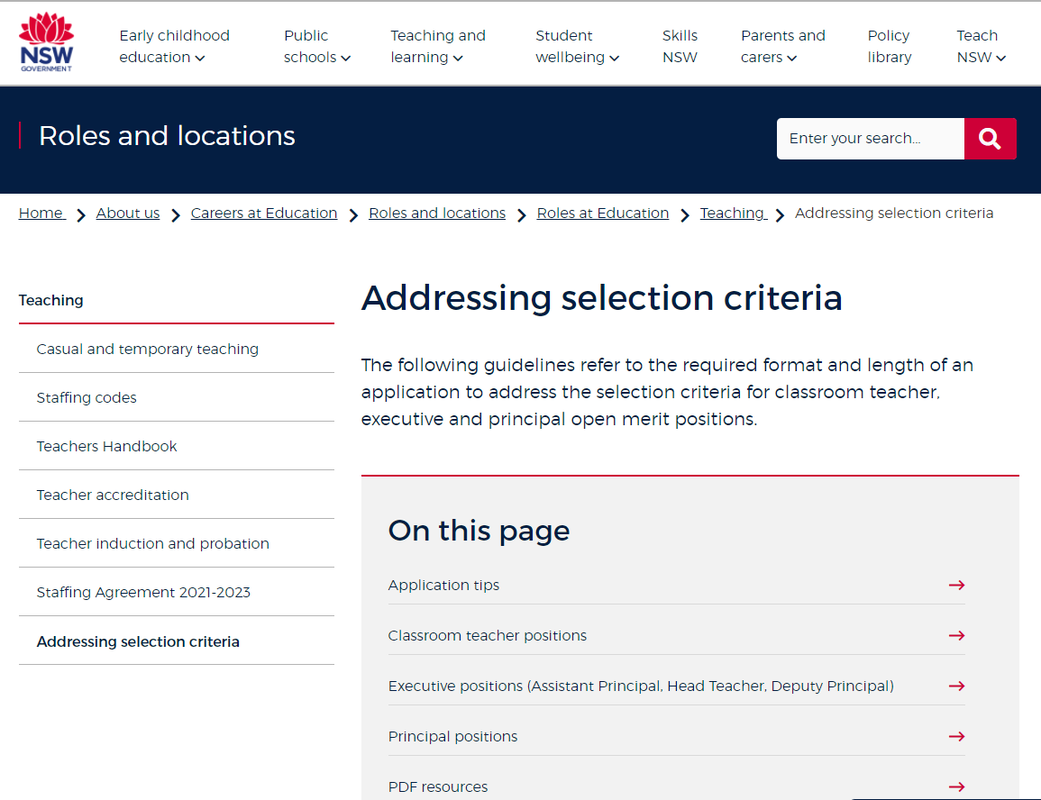
Formatting is hugely important when writing your job application. It can mean the difference between your application progressing or being moved straight to the 'No' pile. 

It is therefore important to always read the job application guidelines set out by the jurisdiction you are applying for.  

The reason there are formatting guidelines is to keep the process equal and fair for all applicants. 
Picture
NSW Department of Education Job Application Guidelines
You need to choose the key points that have had the greatest impact and made the most difference to students, staff and community in a succinct way. 

Deciding on the layout of your application is a personal choice so long as you stick to the guidelines. Make sure you print out the application, so you can see if it is easy to read in black and white. The panel generally won't print it in colour. 

Always submit your application in pdf format so that the formatting won't change depending on what device it is opened on. 

Addressing the Criteria

Job criteria:
  • Spend time teasing out what is the criteria asking for. Sometimes it could be asking you to address two things, sometimes it could be four things.
  • Underline or highlight those specific things, For example: Demonstrated ability to differentiate learning in evidence-based literacy and numeracy programs to enhance student outcomes, including gifted and high potential students.
    • ​Key words: 
      • differentiate 
      • evidence-based programming
      • literacy and numeracy
      • gifted and high potential
    • What ​two points will I use to demonstrate these four key criteria points?
      • ​Look for ways to combine the things you have done to address the criteria and highlight the impact it had 
    • ​Use the school plan to see what it says in the criteria areas so you can get a sense of what they are wanting to achieve and how you might support that with your skills and expertise. 
  • ​Examine the beginning verbs of a criteria carefully because they mean different things, for example;
    • ​Capacity to - have the ability to or are quilified to perform the task.
    • Demonstrated ability - give specific examples of how you have done these things and their impact on staff, students and community
      • using % are an effective way to demonstrate the impact
    • ​Proven experience or proven ability - have work experience that demonstrates practical skills and abilities
  • Backwards map whatyou are going to do to address that criteria and what the school is looking for.
  • If they are looking 'excellence' use the Schools Excellence Framework and read through the 'excelling' column for that particular area so you know what that looks like and what they are working towards.
​Writing Process: 
  • use the same language that is being used in the criteria.
  • begin with ​​a verb - the Australian Teaching Standrads are a good reference point for this. For example:
    • ​modelling 
    • exhibiting
    • leading
    • reviewing 
  • ​the verb you use hooks the reader into that statement sentence and tells them the role you played, e.g. Modelled evidence-based programming and practices with stage team 
  • use the STAR method:
    • ​Situation - context of action
    • Task - What did you set out to do, change or improve? 
    • Action - Giving strong examples of how you did it
    • Results - What was the impact of what you did?
      • ​use a % to highlight the impact, e.g. 78% of students showed a 20% increase in . . . 
      • you need to be able to show why your impact was greater than somebody else with a similar skillset to yours. If you don't think your impact was strong enough, don't include it in your application. 
      • 100% engagement is not impressive to the panel.
      • the panel want to see the growth of the students and specifically how you achieved that growth.
      • Don't make NAPLAN the only source of data you use. Make sure you have a wide variety of data to support growth, achievement and impact.
      • ​Tell Them From Me survey data, quotes from surveys or parent data is all valuable data you can use. 
Look at each unsuccessful application or interview as an opportunity to improve and get feedback on in order to make the next one better.
- Teacher Takeaway Team, 2021

Common Mistakes

There are a number of common mistakes the Teacher Takeaway team have seen when supporting colleagues during the application process. Here are a few things to make sure you do:
  • spelling the school name correctly
  • writing the Principal's name correctly
  • having only 2 or 3 strong main points to address each criteria
  • inform your referees before you apply for the job and ensure they are happy to be a referee for you
  • get permission from your Principal
  • give your referees a cheat sheet about the school and what they are about 
  • don't use too many acronyms
  • never assume the panel will know what you are talking about especially if it is a program they don't use at their school
  • be mindful of your use of bold, underline and italisised font
    • bold your leading action statements - Led the implementation of . . .
    • regular font for you tasks and actions - I have . . .
    • italisise your impact - As a result . . . 
  • ​use what you have done to project into the position using information from the school plan. For example: As a classroom teacher at {x} school I will . . . 
    • Can be integrated into each point at the end of each key point linked back to the school plan or
    • Can be as a statement at the end of that criteria section encompassing the key things you will do at {x} school if successful
Extra Tip:
Call the panel person managing the job and ask them pre-prepared questions you have about the job and the school
  • Gives you another opportunity to make a positive impression
  • Ensure you are prepared with serious questions you have about the position

Interviews

If you are successful in gaining an interview for the teaching or leadership position you have applied for, here are some tips from the Teacher Takeaway team that might assist you in preparing. 
Picture
  • Ensure you know the school plan really well and can talk to it during the interview.
  • Jot key points down on post-it notes so if you are given 10 minutes to prepare with the questions you aren't frantically writing notes.
  • Ask colleagues to do a mock interview with you to calm nerves.
  • When you leave the interview, message the 3rd referee to let them know what you spoke about or a point you felt you missed that they can talk to.  
  • Use a format that you address each question with to ensure you are not waffling. 
    • I believe - What is the core of what I believe about [x]
    • I have - Talking about your experiences and the impact
    • I will - Projecting into the role you are interviewing for
  • For that last question they always ask in an interview: Do you have any more to add? Here are some suggestions on how you might approach it:
    • Address each panel member and clearly state what you will bring to them, such as:
      • [name] as the classroom teacher rep, this is what I will bring to this position as a classroom teacher . . .
      • [name] as the community rep, this is what I will bring to the school community . . .
      • [name] as the Principal, this is what I will bring . . .
    • Also a chance to get in that 'thing' in that you have realised you missed
    • Good opportunity to get your passions across and why the position appealed to you
    • It could also be a short, simple statement 
    • Thank the panel for the opportunity to discuss your application and to interview for the position. 

​If you are unsuccessful in gaining the position, ensure you call up to get feedback about your application and/or interview. Make sure you write down the feedback given to you each time so that you can build a profile.

EOIs

Expressions of Interest are similar to applying for merit selection, permanent positions with the NSW Department of Education. 

The layout, formatting and structure is all set out the same way, in terms of how we answer the criteria. It is a little less formal than a merit selection position, so adding a cover letter is a good idea. 
0 Comments

Your comment will be posted after it is approved.


Leave a Reply.

    Authors

    The Teacher Takeaway Podcast is hosted by four Australian teachers and school leaders. With a wealth of industry knowledge and expertise, Aaron Johnston, Alice Vigors, Rebecca West and James Gray bring all the elements of effective pedagogical practice to the fore in a light-hearted way. These show notes are a summary of each episodes discussion with some added gems for you to takeaway. Happy reading everyone.

    Archives

    April 2023
    March 2023
    February 2023
    January 2023
    December 2022
    November 2022
    October 2022
    September 2022
    August 2022
    July 2022
    June 2022
    May 2022
    April 2022
    March 2022
    February 2022
    January 2022
    December 2021
    November 2021
    October 2021
    September 2021

    Categories

    All
    Aboriginal & Torres Strait Islander Perspectives
    Assessment
    Beginning Of The Year
    Behaviour Management
    Book Week
    Casual Teaching
    Class Formation
    Classroom Environment
    Cognitive Load Theory
    Collaboration
    Collective Efficacy
    Co-teaching
    Creative Arts
    Cyber Safety
    Data
    Differentiation
    Early Career Teachers
    End Of Year Processes
    Expectations
    Explicit Teaching
    Expressions Of Interest (EOIs)
    Feedback
    Flexible Learning
    Flexible Seating
    Handover
    Highly Accomplished & Lead Accreditation
    High Potential And Gifted Education
    I Do We Do You Do
    Inquiry Learning
    Instructional Leader
    Job Applications
    Job Interviews
    Language Comprehension
    Leadership
    Learning Intentions
    Learning Walls
    Literacy
    New Teacher Advice
    Parent Interviews
    Parents And Carers
    Planning & Programming
    Podcast Celebration
    Podcast Guest
    Professional Learning
    Reconciliation
    Reflection On Practice
    Remote Learning
    Remote Teaching
    Reports
    Returning To School
    Routines
    School Culture
    Science
    Science Of Learning
    Science Of Maths
    Season 1
    Season 2
    Season 3
    SLSO
    Student Agency
    Student Voice
    Success Criteria
    Summer Holidays
    Support Roles
    Teacher Librarian
    Teacher Movies
    Teacher Preferences
    Teacher Takeaway Podcast
    Teacher Workforce Roundtable
    Teaching And Learning Cycle
    The Thinking Classroom
    Top 100 Podcasts
    Transition
    Wellbeing
    What Works Best

    RSS Feed

Powered by Create your own unique website with customizable templates.